Bunny blogging!

Song for Europe
This weekend several intellectuals and politicians gathered in Berlin to discuss the cultural politics of the European Union. Their goal:
"To Give Europe a Soul" (auf Deutsch) , as the conference was called.

I have found little reporting on the conference (
I would appreciate any links to articles that people can find), but it seems as if the participants tread on familiar ground. Former German president Weizsaecker emphasized the "mixed character" and classical origins of European culture: Rome, Judaism, Christianity, Islamic Science. Timothy Garton Ash pointed to the struggles for toleration, liberation and rapprochement. If none of these approaches are particularly imaginative, perhaps the conversation itself is a means of defining the culture.
Death of a Disco Dancer
Barista has two interesting posts. One is about
the children who sang the verse of Another Brick in the Wall part II. The other is
an unusual case of live journaling that is too unusual to describe.
Just go read it.
Couldn't someone have just bought her a Joy Division or Dream Syndicate records?
Larzac
As I mentioned earlier, I am reading Herman Lebovics
Bringing the Empire Back Home, a book about contemporary French politics after decolonization. A point that he makes is that the new regionalism, or
post-colonial regionalism, arose within the context of decolonization. Retreat from the world placed greater pressures on the French metropole, especially in agricultural sectors. What is interesting is that these farmers, usually described as conservative, connected their struggle with struggles for liberation and against globalization. The larger question, which Lebovics does not enunciate, is whether or not the question of decolonization leads directly to critiques of centralization:
why should the national capital monopolize power if national conflict within Europe and imperialism have come to an end?
The origin of the radical regionalism was the fight against the expansion of military bases at the expense of farming in Larzac in the 1970s. The project was conceived by Michel Debré, a nationalist who served as minister of national defense. Debré advocated unilateralist policy toward North Africa as a means of protecting French interests; the expanded base would serve as a training camp for overseas interventions and a prison for foreign fighters. (Deja-vu, anyone?)
The farmers resented Debré's arrogance: he took little interest in the shape of the communities, their environment, or their future. The government started to buy up land in the area south of the Central Massif. The "Larzac Movement" attracted leftist intellectuals who felt that they had been shut out of the post-1968 nation, but they were tangential to the movement. Instead it produced political figures who associated the farmers' struggle with resistance groups around the world. The farmers also took on regional identities, incorporating the symbols of Occitan (south France) into their movement.
The farmers were creative. They would break into government lands and confiscated farms with their tractors; then they plowed the fields and seeded them. On other occasions they flooded the countryside with sheep in order to block the roads to military vehicles. They also engaged in more traditional resistance: collective squatting. The state reacted by withholding infrastructure improvements to the area: they refused to build and maintain roads and telephones. It was believed that the peasants would not be able to organize to prevent the demolition of farms without them.
Eventually, the Larzac Movement was memorialized in Mitterand's decentralization policies of the early 1980s ("Avem gardet lo Larzac").
Le Corbusier in America
The Boston Globe has an article about
Le Corbusier's only work in America, Harvard University's Carpenter Center. (And yes, I am no fan of his work).
[W]hen Sert offered him the job, Le Corbusier was still angry at what he called "American officialdom" for his treatment during the design process for the United Nations headquarters, where he had been turned down for the commission only to see his ideas incorporated into the final complex. Ultimately, though, he couldn't turn down the chance to build in the United States, a country that early in his career had represented for him the possibility of the machine age. And the Carpenter Center's role in both housing and embodying Harvard's arts program coincided with his idea that architecture should synthesize all the arts, including painting, sculpture, and even music. As the architectural historian William Curtis has written, Le Corbusier wanted the building to be a "manifesto."

Le Corbusier only visited Harvard twice, but one of his most vivid impressions of the place was the overlapping tides of students that filled Harvard Yard as pealing bells signaled the break between classes. "He was fascinated by that," Sekler recalled in a recent interview, "how it suddenly came to life."
... But the building didn't turn out exactly as Le Corbusier envisioned it. The electronic tones were dropped early on. More significantly, he was forced to abandon his plans to cover the building's external spaces with a garden, an extension of the greenery of the Yard. Unlike the manicured quads, he had wanted it to be a natural, untended garden -- seeded entirely by the wind and birds and insects, watered by the rain and allowed to run riot all over the building's several terraces. The idea didn't particularly appeal to the Harvard administration, and a lack of safety rails rendered most of the proposed space off-limits anyway. Today only the lower front terrace has a garden, and it's a rim of dirt thinly covered in summer with weeds.
Quarter Identities

Initially I liked the idea of placing different images for each state on the tail side of quarters. It was a means of giving variety to American currency, something interesting to look forward to and a way of learning a little something about each state. But I think the results suck.

Few of the state quarters are visually compelling (I reserve praise for
Connecticut,
Virginia,
Vermont, and
Iowa). Most offerings could be logos for banks (like
Massachusetts and
New York), sports teams (like
Texas), or vacation bureaus (like
Rhode Island,
Ohio and
South Carolina). Certainly the designers can do more than create a constellation of symbols with the form of the state in the background. By far the worst offender is
Wisconson. Is it a dairy ad? Got milk?

Random Notes
Thanksgiving went well. One of the dishes I cooked up, a couscous with dried fruit, was a disaster because I added too much cinnamon (the lesson is, don't confuse teaspoons and tablespoons). My other dish was much more successful.
We also checked out a new Tibetan restaurant in Northampton. Pretty good. When I got home, I tried to replicate the potato dish that I had with some success (using garlic and ginger sauteed in butter and simmered in a small amount of liquid).
Recently we have watched a lot of movies; all of them show the deep, complex landscapes.
Down by law was great, although Benigni carried the second half. The outdoor scenes are wonderful, showing the depth of the urban blocks in Louisiana. Talk about inventing traditions, we finally watched
Lawrence of Arabia. The story was paced perfectly, allowing the viewer to fall in love with the vast deserts and high mountains. Finally, the Scottish film
Ratcatcher, shows the claustrophobia of youth trapped in Glasgow in the 1970s. It takes place during a strike by garbage collectors that affects the health of the large tenements in which the main characters live. Their lives evolve around an unused, infested canal that cuts through their neighborhood, taking their children and making them ill (mostly morally). The director went out of her way to show the cruelty of the children (something that bothered me). Nevertheless, an excellent film. (I wonder: do the English tease the Scots about how they speak as Americans tease Canadians?)
The death of me will be the
South Park movie. Comedy Central shows it twice a month, and every time my wife and I get sucked in. We must watch at least long enough to see Cartman tell his math teacher to "suck his balls."
Claire points out
two reviews of books on Weimar Berlin, that romanticized city of decadent cosmopolitanism. The milieu of cabarets and experimental arts has made a big comeback in historical studies, especially as people have returned to the relationship of art and politics. How funny that the
ewige junge Stadt (eternally youthful city) would not shape Germany for almost six decades; all the ideas would come from the south (Munich and Vienna), the east (Moscow), and west (Bonn, Frankfurt and Paris).
Whiskey River has a post about
the meaning of landscape in Chinese culture and how it references specific topographic features and their symbolic use.
What will he eat next?
Tuivel is, for a rabbit, without scruples. We have discovered that he will eat almost anything.
It started a few days ago. I was hunched over on the floor, looking at a newspaper and casually eating an asiago cheese bagel. He took it from my hand and ran away with it. I could have dismissed this incident. He may have wanted the bread more than the cheese. However, my wife decided to test his limits. She brought him a small cube of gruyere, which he ate with glee.
Yesterday, my wife tried more. I had made betzels, a filled pastry from North Africa that I make with Phyllo and fry in oil. I made some for Thanksgiving dinner (so much for invented traditions), using garlic, egg, gruyere and sauteed spinach. He loved it.
Today, my wife tried something most rabbits would resist. She offered Tuivel roasted garlic. The pungence should have scared him away. But
HE ATE THAT TOO.
What next?
Thinking like a continent
James Drake has an interesting article in
Journal of World History (15.3, 2004) (
here, Project Muse subscription required) that explores how Americans came to think of themselves as (in his words)
a continental society. He compares two cases, Anglo-America and Spanish America, to see how the people conceptualized their relationship with the land they inhabited as well as Europe.
The larger current has to do with geopolitical thinking. Continents became a category that interested European intellectuals, especially as they attempted to understand differences between themselves and the peoples elsewhere in the world. Europe had natural barriers that allowed civilization to flourish without excessive war, unlike other continents.
The English colonists combined the category of the continent with their perception of the relationship with the land. Drake sees the Boston Tea Party as revealing: it shows how the colonists identified themselves as the new indigenous people of the Americas. It was not just the local Native Americans that they were replacing, but a whole continent of people who, in their opinion, did little to develop the civilization of the continent. The new Americans were there to do what the old Americans failed to do.
Drake, in the process of comparing Spanish and Anglo-America, draws on an event from Mexican history that resembles the Boston Tea Party. The Spanish Mexicans never saw themselves as the replacements for the natives; they were overlords and conquerors. Nevertheless they took the identity of Indians to protest the policies of the mother country:
Under the leadership of Hernán Cortés's son Martín, who had assumed the title Marqués de la Valle de Oaxaca, a number of colonists planned a rebellion, feeling the crown had violated their rights. As heirs of the conquerors, they saw their fathers' rewards as their entitlement, their just inheritance. After the conquest, the Spaniards had divided among the conquerors the right to extract tribute or labor rights from the region's Indians. This lucrative institutional arrangement, known as the encomienda, had long proven a sticking point in relations with royal authorities. Hint of its demise at the hands of royal authorities regularly ignited discontent.
When rumors circulated in 1565 that the crown intended to withdraw support for the encomienda, conquistador elites and their heirs conspired to revolt. This plan, known as the conjuración del marques, never reached fruition, but in a dramatic ritual these colonists asserted their views. Donning the garb of Mexican chieftains and Indian warriors, they paraded through the streets of Mexico City toward the house of Martín Cortés. When they arrived Cortés flung open the gates and the crowd gave him a crown of flowers. Accepting the offering, Cortés returned to his business and the "Indians" dispersed. Cortés and his fellow demonstrators had symbolically reenacted the submission of Moctezuma to the Spanish. When the leaders of the incipient revolt were later put on trial, the judges saw the meaning clearly. In marching through the streets dressed as Indians and handing Martín Cortés a crown, the demonstrators, in the words of one judge, "meant to indicate that the Marqués was to be king of this land.
Contested authenticates
Thanksgiving, for Americans, starts a long season of hyperactivity consumerism that has become the hallmark of year-end behavior. There is no denying that a ritual of shopping has emerged, and that few (even the atheists) can offer any meaningful resistance to the "holiday season."
Sharon has already received some guff for saying that Thanksgiving is
"... a classic Invented Tradition ... ." (Hopefully, she won't mind a little more.)
There are few cultural practices that originate before 1800 or whose meaning has not been radically altered since. Carnival, for instance, is by no means a modern invention, but the festivities have been better defined over the modern period than any longer duration. The evolution of Carnival (into its currently codified form) was a reaction to the process of modernization (nationalism, secularization, tourism, consumerism, etc.) as they were experienced in different contexts. In other cases, practices transcended their temporal and spatial bounds in order to achieve broader, more often national, importance.
Why should we care whether or not a tradition has been invented? Should historians judge the authenticity of culture, looking to locate the roots of practices in antiquity or folklore? Given that most of the nations of the world are young (less than two hundred years), their national festivals could be nothing other than recent constructions, nationalizations of local cultures, or secularizations of religion.
Historian discovers that films are fiction
Historian David Crowe has published
a new, academic biography of
Oskar Schindler wherein he claims that
Schindler's persona and legend have been hyped up. His actions were actually more ambiguous than courageous, and his efforts to save Jews only a small part of a self-indulgent life. The film portrayed him falsely as a hero.
"Steve is a very wonderful, tender man," Mr. Crowe said of Mr. Spielberg, "but 'Schindler's List' was theater and not in an historically accurate way. The film simplifies the story almost to the point of ridiculousness."
I have questions about why Crowe has taken on Schindler and the film. One of Schindler's List's major themes was the man who rises above his pettiness just once in order to become the hero. Crowe makes the same argument himself, but makes it seem as if the film turned him into the classical hero. Crowe's argument goes into pettiness itself, focusing on minutiae and criticizing it for not reaching standards of "truth" that films, in general, don't promise.
He dismissed some scenes in the film and book that are part of Schindler's legend. For instance, in the film Schindler is shown riding with his mistress on Lasota Hill in Krakow and watching the clearing of the ghetto in March 1943, when he sees a little girl seeking shelter. The scene depicts Schindler's moral awakening, but Mr. Crowe called it "totally fictitious." He said that it would have been impossible to see that part of the ghetto from the hill, and that Schindler never saw the girl. Schindler's transformation was more gradual, Mr. Crowe said, and even before the ghetto was cleared he was appalled by the mistreatment of the Jews.
Attacking the narrative devices of film is a straw man. Is it so important that Schindler had a moment or months of revelation? Certainly historians are not immune to this problem: even Thucydides inserted the legend when he had experienced the real events.
Amazing Snooze
I have yet to get into this season's Amazing Race. I even missed the first half hour, preferring to read (
Governance of Europe's City Regions--I am a nerd). The teams are competitive rather than personable. Jonathan, the abuser, should be dropped from the competition as soon as possible. His behavior should not be tolerated. At least Gruff Gus will hang around for another week.
Periods of Western Urban History
Aidan Southall (
The City in Time and Space,
read a review) attempts to provide a comprehensive framework for urban history on the global scale. His periodization (Asiatic, Ancient, Feudal, and Capitalist) is based on Marxist theory: the form of cities is determined by creativity, production and wealth. More importantly, cities are sites of disparities and contradictions: intellectual freedom, the manufacturing of prosperity, and social divisions.
After discussing some early forms of urbanization (like
Çatal Hüyük), which were more large settlements attached to agricultural endeavors, Southall looks at the settlements formed in Ancient Mesopotamia. These cities are more important than the ones that came before because they are a product of a rich economic milieu that leads to political organization, whereas earlier cities are isolated phenomena. In the
Asiatic Mode, cities are ritual centers for agricultural regions (like
Eridu). There was not clear difference between "town and country" at this point. Increasingly urban cults developed administration in order to organize agricultural production and income. As imperial expansion occurred, the cities became hierarchalized: settlements submitted to the authority of more powerful entities (like Uruk), but the indigenous political structures were not changed. Some form of political elite emerged, but society was mostly egalitarian.
The
Ancient Mode is characterized by ruralization and the emergence of the
polis. In the Greek city-states, rural elites withdrew from the countryside, maintaining agriculture as a source of wealth, and segregated themselves from the rest of the population. Within the city they developed freedoms that allowed genius and creativity to emerge. The shape of the city was determined by the politics of the city: the
agora (public assembly), public temples, and walls. Political participation was encouraged through public venues in order to increase the loyalty of the citizenry. But the polis was exclusionary: it was based on the domination of the hinterland, the redefinition of non-owning producers as slaves, and limiting participation of women. Greece was particularly influential in that standards of urban planning appeared that were applied elsewhere in the Mediterranean world, making all cities familiar.
The
Feudal Mode stands in relation to the ancient. Few new cities were built, and those Ancient cities that survived fought degeneration. Many were the targets for plundered. The buildings, for the most part, grew older: people were aware that they were living in the shells of Greek and Roman accomplishments. Gothic, of course, is one example of how cities were built up. The urban space started to become distinct from the rural. Political power was based on agricultural domination, but those forces were not located within the city but closer to the sites of production. Furthermore, feudal lords attempted to dominate the cities, but with little success. "Town and country" opposed one another. From within the walls the merchants ascended politically, laying the foundations for the next phase.
In the
capitalist mode cities are centers of accumulation. They control productive regions and are even productive forces in their own right. The impulse of capitalist city is also imperial. The need to export leads to the creation of colony cities throughout the world.
Note: Southall explores differences of urbanization in other parts of the world, which are striking.
Innovative milieus
[A little theory?]
The current issue of
Economic Geography (Volume 80 No. 4, October 2004) focuses on trends in French economic geography, in particular what it calls
the new socioeconomic geography as represented by the GREMI group. The new approach focuses on territory as an a priori factor in economic development, a "cradle of innovation".
Olivier Crevoisier's article, "The Innovative Milieus Approach: Toward a Territorialized Understanding of the Economy?", describes the spatial influences on economics: technology (as produced by intellectual organization and creativity), organization (networks related to production and capital, etc.), and proximity (relation of the territory to various resources, both physical and virtual). The territory is an
innovative milieu in the sense that it mobilizes these three internal properties: its universities, its financial institutions, and its geographic relationship to markets. Cervoisier points out that cities hold "a privileged place for something new" because they combine intellectual and financial forums and because they are nodes for various global networks--it is difficult to dissociate the city from territorial development.
Nationalism tamed?
This article about J. Gordon Liddy and how fascism influenced his life should raise questions about how much extreme nationalism can be tamed by removing its racism. Simply put: its aggression is transferred into other realms.
This gave Liddy hope "for the first time in my life" that he too could overcome weakness. When he listened to Hitler on the radio, it "made me feel a strength inside I had never known before," he explains. "Hitler's sheer animal confidence and power of will [entranced me]. He sent an electric current through my body."
Ceremonies of Liberation
There were several ceremonies throughout Alsace to commemorate the sixtieth anniversary of its liberation. Only one American who participated in the liberation,
Paul Stadler, was present at the main event at the Strasbourg Cathedral.

Many of the speeches attempted to strike notes of cultural reconciliation. Some described the final expulsion of the Germans as the moment when rapprochement between France and Germany could truly begin. Raffarin, adding a little bit of contemporary politics, compared the oppression of the occupation with the current religious intolerance against Jews and Muslims:
J'ai pu constater avec révolte que, rompant avec la tradition régionale et nationale de respect des religions, certains extrémistes avaient profané des lieux de cultes et des cimetières de toutes confessions. Souvenons-nous de René Char : le mal vient toujours de plus loin qu'on ne croit et ne meurt pas forcément sur la barricade qu'on lui a choisie.
Here are the links to various articles:
- Testimonial of Maurice Lebrun, who led a Moroccan division and raised the national flag above the Strasbourg Cathedral.
- Rembering the Oath of Koufra, taken first by the soldiers of Leclerc in 1941, not to put down their weapons until the entirety of France was liberated.
- DNA has started day by day articles on the coverage of the liberation.
- An extensive article on the first village to be liberated, Seppois-le-bas.
Random Notes
I am relieved that the damned presentation thing is over. I am glad it’s over. How well did it go? My paper was not as well organized as the others, but I think I left it open enough to generate some better questions from the audience. Now I want to stop thinking about French republicanism. For the next month, I will ignore the French side of my subject. There is only one problem. Some guy talked to me for fifteen minutes about how intolerance of regionalism could be used to understand intolerance of Muslims in France. An interesting question, but for later.
Last night my wife and I watched
Laissez-passer (Safe Conduct). Bertrand Tavernier is my favorite contemporary French director. This film, based on real experiences, deals with the French film industry during the occupation. The action surrounds writers and directors that was overseen by the SS. As a micro-study it does an great job of showing the extent to which resistance and non-conformism required collaboration. And after watching it, I want to see many of the films that Tavernier depicts. Two critiques, which apply to all Tavernier films: he tends to cast people who look similar to one another, and the dialogue can be so rapid that subtitles are somewhat ineffective.
We also had a mini-fest of
Planet of the Apes. It got me thinking about how concepts of degeneration (and the requisite fragmentation of humanity) must necessarily lead to speciation.
I am completing the syllabus for by Ancient Civ class. Advice that I got from someone yesterday: find the two best books on the subject; assign the second best, teach the best.
I am happy with the progress of
Dictionary of Received Ideas: lots of good things to read. I want to thank whomever changed the format. It looks better now.
Decentralizing Patrimony
Are Raffarin's plans for decentralization and regionalization of France dumping more competencies on régions and communes than they can handle? Increasingly it looks like the national government is divesting itself of domestic policies and forcing the régions to pick up the slack. The current project turns over the
maintenance of historical sites and monuments (en français). The commission Rémond established that the national government should only care for monuments and buildings of national or great historic importance. Regions and communes must assume responsibility for all others. It is not clear that they can handle the load. Some sites bring in profits for localities: it should be easy to administer them. Others, like ancient sites in Brittany, are remote and fragile. It is unclear whether local governments can adequately provide for upkeep and preservation.
On a similar note, officials in Madrid are considering what they will to with
the last statue of Franco (auf Deutsch).
Alexandre Millerand, commissaire-général
I am presenting a paper at a graduate symposium tomorrow. The title:
No Place like Alsace: The Fate of Regions in France, 1918-1925. It describes the attitude of the French administration to regional institutions and how the question of their preservation influence the discourse on national territorial reform and decentralization. The Herriot government ultimately decided no territory could have political institutions that were not granted by the state, and Alsace would be abolished. Abolishing the example of Alsace-Lorraine undermined the discourse of reform.

Writing the paper, I realized that a great article about French republicanism was emerging. But in the context of a twenty minute presentation two-thirds (perhaps more) of what I wrote has been cut out. One person whom I had come to appreciate is
Alexandre Millerand (1859-1943). He was best known as the
minister of war during WWI and prime minister and president in the mid-1920s. He also spent over a year (1919-1920) as the commissaire-général, a special office created as the executive head of Alsace-Lorraine during the transitional period.
Millerand might have appeared to be the perfect candidate for this job. In his opinion recovery of Alsace-Lorraine was the minimal condition for French victory. (He realized that full gallicization was preferred). He learned to appreciated Alsatian institutions, and he wanted to extend them through out France. His pet projects were the creation of other territorial executives (like the commissaire-général) and regional parliaments, both with the ability to create policy and law independently of Paris. There were other things he wanted as well: the German pension laws, which he had preserved for retired Alsatians, was more comprehensive than French and should become the national standard. There were other ways in which Millerand wanted to reform from the region to the nation.
Looking at the "fine print" I have become more conflicted about Millerand. Whereas he seems to be a fan of the region, I realized that he had some anti-democratic tendencies. He was a socialist, but his positions continually drifted to the right. He was unimpressed with popularly-elected officials: he preferred assemblies that were composed of indirectly chosen professionals. That example resembled the Alsatian lower house, a senate that was composed of imperial appointments and representatives of guilds, universities, municipal councils. The upper house was the body of popularly elected representatives. Alsatians fought for the latter; Germany imposed the former. He was not the only politician of the era who preferred government by experts rather than democracy. However, there are some important questions about how this affected his image of territorial France. Which regionalism did Millerand like: the republic that Alsatians tried to create, or the authoritarian institutions that the German Empire used to limit popular sovereignty?
Dictionary of Received Ideas
OK, I am going to try the link thing again in a different format. I started a new blog at
Dictionary of Received Ideas. (Somehow I thought it was an appropriate name for a
blog about
knowledge.)It will be a group blog that will allow people to crosspost stuff and links that they find elsewhere. If people want to join as a member, they need just contact me (and get a Blogger account). I have done nothing with the format, so I am up for suggestions.
Pumpkin Soup
I have been in a big cooking mood. Since Thanksgiving is approaching (US nationals only, please) I want to throw out one of my favorite pumpkin soup recipes, an amalgam of difference recipes involving pumpkin that I have tried over the years. It is an easy and quick recipe, depending on how long it takes you to peel a pumpkin (I recommend cutting one inch slices first, than removing the skin from the individual slices). It has a slightly Indian flavor without going overboard.
Ingredients
- 2 tablespoons olive oil
- 1/4 to 1/2 teaspoons whole cumin seed
- 1/4 to 1/2 teaspoons whole black mustard seed
- small onion, chopped
- small to medium sugar pumpkin (enough to yield 1 and 1/2 pounds flesh after peeled and seeded), cubed
- medium potato, thinly sliced
- four cups vegetable broth (meat eaters can use chicken broth at their own risk)
- salt and pepper to taste
- heavy cream
Heat the olive oil in a medium pot. Stir in the cumin and mustard, stirring a few times. Wait until it pops a few times, then stir in the pumpkin and onion in two to three batches. Make sure that the oil and seeds coat the pumpkin well. Let it heat up for about five minutes. Stir in the potato, than cover with the broth. Increase the heat to high. When it starts to boil, reduce heat to low, cover, and let simmer until the vegetables are soft. It shouldn't take too long. Remove from the heat and puree. Add salt and pepper. Pour small swirl of cream into the individual servings.
Random Notes
A question that people are dancing around in various posts on the internet:
why is nineteenth century Europe still the bottleneck through which all histories must flow? It is a question that involves the roots of western civ, international relations, the periodization of history, and the normativity of the nation-state. I expect to have some thoughts soon.
Tuesday's Amazing Race
sucked. Too many models, too many thespians. Jonathan, the entrepreneurs, is completely abusive. Colin was abusive, but watching him implode was fun. Everytime I see Jonathan, I think, "where are the police?" How will he react when the teams need to interact with the natives?
Geitner considers how
public spaces framed electoral events; he even has excellent photos of JK speaking. Jonathan Dresner's article on
constitutional reform in Japan is a must.
History Blogging
Here is a collection of links to blog entries dealing with history and historical practice that have appeared since Tuesday
So far, I do not think that this is a successful effort. I hoped to bring together links from outside the circle of blogs that I normally read. I'll try it for another week. However, I think that any sort of collection of links should be a collective effort, and
it should be given a blog of its own.
AIDS Vaccine
I don't know how far American nationalism has gone, but I have not found an English language source about the
Pasteur Institute's success cultivating
a vaccine for AIDS in rabbits, or
the testing of the vaccine in humans. (Of course, I want to know that the rabbits will be alright.)
Fantasies of Skin Color
Rotem Kowner has an interesting article in Ethnohistory,
Skin as a Metaphor (Project Muse subscription required), that deals with European perception of the Japanese during the period in which Japan was isolated. The evolution of perception was due completely to the changes in scientific discourse in Europe, which increasingly obsessed on skin color. Although they did not escape becoming an inferior race, the Japanese were not described with the same harsh language as other non-Europeans.
[Linnaeus'] followers maintained his focus on color as a major component of their racial classification: The Scottish anatomist John Hunter (17281793) depicted Mongoloids as brown, whereas Johann Blumenbach was apparently the first to depict the peoples of East Asia as yellow. This color better suited the Japanese, for whom the designation brown was frequently far from reality. The Europeans could easily see yellow in others' skin color because it is so vague, and it was enough that a few members of a group were perceived as such to generalize the characteristic to the whole group.
In 1775, the year Blumenbach's book was published, the Swedish botanist and Linne's disciple Charles Peter Thunberg (17431828) left for Japan. Thunberg, who worked as a physician at the Dutch mission for one year, was the first naturalist of the new school to examine the Japanese. A decade later, when Thunberg wrote his own account of his experience in Japan, he depicted the Japanese as having "yellowish colour over all, sometimes bordering on brown, and sometimes on white."
Let's have a woman, an African-American, and an Hispanic before we make more white men eligible for the presidency.
Swept in the series, but ...
An Angel still
won the MVP. Cool!
 I love this quote:
Anaheim manager Mike Scioscia said Guerrero was “at times carrying our team single-handedly."
Random Notes
I have been plugging away at the paper I am giving this weekend: the French administration's desire to abolish Alsace-Lorraine in the early 1920s. So far it is quite long (more than I can fit into the fifteen minutes that I have been given) so I will have to use some heavy editing. I am also putting together a proposal for a paper on the competition between cities to establish a Rhenish Museum in the late 1920s.
I have given a quick glance at Herman Lebovics' new book on contemporary French politics,
Bringing the Empire Back Home: France in the Golden Age. It deals with the debates over migrants and regionalization: discussions have been clouded over by the legacy of republicanism that have made France look more homogeneous.
I should note that Chirac and Raffarin are rejecting Sarkozy's suggestion that the 1905 secular laws should be moderated to let religion (especially Muslims) come into French public life. But will the intrusion of the state into religion go beyond what there neighbors will do:
Muslims may be forced to pray in German.
I am so glad that the new Secretary of State already has
the respect of world leaders (auf Deutsch).
By the way, I am frustrated with reading. I feel as if I never complete books any more. I have been picking away at Stephen Baxter's
Evolution for weeks. I highly recommend the book (fictionalization of the emergence of man since the extinction of the dinosaurs--hard sci fi that is really dramatic), but I have had so little time for concentrated reading (for pleasure) that I can read no more than a few pages at a time. And yet I have read parts of numerous books in the last few days.
I am trying hard to put the elections out of my mind (avoiding all the tin foil haberdashery). Fellow Cliopatriarch
Jonathan Dresner sent me
this link that divides the nation into ten regions on the basis of political orientation. I am impressed by the sophistication of this map, avoiding cliches about geography and mentality. It is too early to make predictions, but I think the next Democratic candidate for the the presidency should come from
here. I am reminded that the Bush administration wants to divide the country into ten regions for the purpose of medical insurance. The idea is that insurers should provide coverage for the entire region, and they would not be able to to farm only the rich communities. I wonder if there is any correlation between the two models.
In the mood for some philosophy? Brandon has some interesting remarks regarding
temporal perception in the works of Augustine.
Amazing Race 6 is coming up. Like
Brdgt, I am not impressed with the contestants (with the exception of the ex-CIA guy and his daughter, this season's version of the vet-daughter combo). This description for this
ex-couple disturbs me:
Rebecca's first impression of Adam was that he was gay, but after he pursued her for months, he proved otherwise.
WTF? What kind of test proves heterosexuality, and why does it matter? Is CBS trying to prove that the contestants have been properly screened?
Process over Identity
Since the days of Schuman and Monnet European integration has been more about process and cooperation than expressing identity.
American unilateralism is probably giving Europeans something to integrate against, speeding up the process: desire to gain freedom from American influence, withdrawal of American resources to other parts of the world, pure European successes in global diplomacy.
Links Deposit
I suggested several days ago that there should be some way of bringing together blog posts about history and historical theory and methodology in one place. I guess I will try, at least once, to do this myself.
Here's how it will work:
- All the links should be written into the comments of this post. You can also e-mail the information to the address in the sidebar.
- They should include the following information: name of blog, name of post, web address, general areas (Europe, Africa, Women, Science, Ancient ...), and a brief, optional description of the subject (no more than ten words). I don't want to replace other people's posts about the links that they discovered, so I want the information to remain brief.
- I will post the list on Friday or Saturday. If you want a copy e-mailed to you, please tell me.
One more thing: there are a lot of posts out there that use history to argue politics. I write some posts like that. In my opinion, these are politics and not history and should not be included.
OK, let's see how this works!
He could have been president. He should have been president.
The Degenerate Adam
In
her book about French naturalist and feminist
Clémence Royer, Joy Harvey describes how Royer produced one of the most heavy-handed interpretations of Darwin's Origin of Species by translating it into French. Royer was more of a popularizer of science that a scientist herself. She looked out for ways of bringing scientific understanding to a broad audience. To her credit she was one of the first French women to become a member of the Society of Anthropology.
Royer learned of Origin of Species through a book review. She appeared to have the right skills and knowledge to understand and translate the book. However, her translations was weighed down by her desire to make the implications of Darwin's ideas as explicit as possible, and to correlate Darwin with her own ideas about morality. She added a preface that directly attacked Catholicism and all organized religions. She added extensive footnotes, and she removed spots where Darwin expressed doubts about his own theories. (More confusing was the decision to use élection naturelle in place of natural selection: election implied moral choice, but selection had no equivalent in French.)
Royer was particularly interested in how Darwin's ideas could be used to explain degeneration.
Royer's preface also included a lengthy description of the consequences of Darwinism's evolution for human beings. In a section that gained her instant notoriety she made the first eugenic suggestions about the consequences of natural selection. ... she argued that [because of Christian charity and pity] the human race was "aggravating and multiplying the evils that it argued that it pretends to remedy." She added that, through the excess of devotion, human beings regularly "sacrifice what is strong to the weak, the good to the bad ... beings well-endowed in mind and body to vicious and malingering individuals." ... she posed the issue in a manner that seemed to imply the need to eliminate such individuals. The preservation of "beings incapable of living by themselves" weighed heavily "on the arms of the strong." ...
The effect of marriage and mating selections on human society and particularly on women she extended and maintained throughout her life. Through the selection of partners on the basis of passivity and beauty, men had weakened human development. Women tended to pass these characteristics on to their daughters, but were saved by the mental and physical strength that they inherited from their paternal ancestors."
Darwin agonized over the French translation. He felt that he was misrepresented to his French audience, and he battled with Royer in order to make changes to subsequent additions
Imagining provincial Iraq
Fred Kaplan and
Juan Cole are debating whether some new subdivisions for Iraq will help to ease ethnic tension. They differ on whether there should be larger regions that encompass the major ethnic groups (between three and six territories) or smaller that better represent social and tribal structures (on the order of eighteen territories) respectively.
Prof. Cole comes up with a few reasons why smaller regions should be preferred over larger regions. First, the creation of a "Kurdistan" will cause tensions between the ethnic majority and the Christian and Turkmen minorities. Second, larger provinces are a prelude to partition, drawing boundaries that define the players in an eventual civil war. Third, smaller provinces have already been established: they have already proven to be a " bulwark against ethnic cleansing" and will help to stabilize the country as prosperity begets internal migration.
There is every good reason to keep the territorial structure as it is. It has a history of its own. The provinces themselves match up with existing social structures.
However, the preservation of the eighteen provinces does not preclude the creation of larger territories to encompass them. The eighteen can be maintained as administrative entities for the state while regional power is represented by larger regions. There can be a "congress of Sunni territories", and perhaps there should be.
Regionalism works best when there are multiple levels to intermediate government, each of which is a different mixture of popular participation and state administration. Better to have eighteen provinces
and five regions.
Furthermore, the preservation of eighteen provinces does not guarantee that forces that oppose the government will remain fragmented. The notion of ethnic regions, like Kurdistan, have already been imagined and, to some degree, operationalized.
If the existing provinces don't appear to fulfill political ambitions and interests, people will fight for imagined regions in their stead.

No use pretending.
Winter is here. The land has lost its color and it is falling under a perpetual chill. Blah!
Newsletter
Normally I am no fan of centralization (look at my topic), but I would like to bring together links relevant to the history blogosphere. Something simple, like a list of links to posts that refer specifically to the subject, theory or method of history (not politics) and a one sentence description that can be passed around on a weekly basis.
Anti-Nazi Youth in Cologne
The
Edelweiss Pirates (in English), an anti-Nazi movement from Cologne, is finally gaining recognition from Germans. They were an alternative to the Hitler Youth, establishing a counter-culture youth movement that copied other
Jugendbewegung.
Towards the end of World War Two, there were about 3000 Edelweiss Pirates in Cologne and several hundred more in neighboring cities. They developed out of a youth hiking movement called the "Bündische Jugend" which was neither aligned to a political party nor a church but there was no organized structure and several loose groupings of Edelweiss Pirates existed in each suburb of Cologne.

With the rise of the Nazi’s in the thirties, these young people refused to join the Hitler Youth. They were like any other teenagers rebelling against the authorities. However this was a totalitarian state and rebelling could cost you your life.
... According to Dr [Nicola] Wenge the Edelweiss Pirates established their own subculture in the Rhine-Ruhr region by wearing a certain style of clothing, singing their own romantic ballads and later anti-nazi ditties.
Unlike the Nazi youth organizations, girls and boys interacted together and traveled for weekend hiking trips to nearby Konigsforst. "For this reason they were persecuted by the Hitler Youth, the police, the Gestapo and even the Nazi judiciary and branded as criminals, sexual deviants and as threat to the state," says Dr Wenge.
As the allied bombing of Cologne intensified, the city, as well as public order crumbled, and the childish pranks and fisticuffs with the Hitler youth grew more serious. Jean Jülich and his band of friends took to throwing bricks through munitions factories and pouring sugar water into the petrol tanks of cars belonging to Nazis. Other groups derailed train carriages loaded with munitions or distributed leaflets critical of the regime.
In 1944, Jean along with several of his friends were arrested for allegedly being involved with a man called Hans Steinbruck or Bomber Hans who was reportedly plotting to bomb the Gestapo headquarters in Cologne. Jean was fifteen years old and spent four months in a tiny cell at the Brauweiler prison on the outskirts of Cologne. He and the other prisoners were interrogated and tortured by the Gestapo. And then one day, Jean said some of his friends, including Bartholomaeus Schink were taken away. In all, 13 people were hanged early in the morning on the tenth of November 1944.
Island Crucible
The separatists of Corsica have expanded their war against France. They are now
attacking North African immigrants (in English) who have taken up residence on the island:
... The inhabitants of a peaceful, suburban neighbourhood of the northern city of Bastia repair the walls around their gardens. They were damaged when a huge blast destroyed the house next door. The owner of what is now just a charred ruin of twisted metal and rubble is a Moroccan tile worker. He had almost finished building the villa of his dreams. Meanwhile, estate agents in Bastia have been warned: Don’t sell to North Africans or face the consequences.
Beneath one of the splendid Baroque churches of Bastia, most of the stall-holders and most of the customers at the market are North Africans. To the outsider, it seems to be a place where the cultures of the two sides of the Mediterranean can mingle under the shade of the plane trees.
But the reality is much darker: it is a community in trauma. The area is full of destruction: torched cars, a bombed out pizza parlor, bank and shops. This is part of 56 acts of violence against the island’s North African community over the past year -- as many as in the whole of the rest of France put together. Two underground nationalist groups called the Clandestini Corsi and the MCA that emerged this year have claimed responsibility for many of the attacks, which, they said, are aimed against the drug trade.
Far West and Far Far West
Are we making too much of the red-blue maps (in whatever configuration)? I think I had my say about
political divisions by region way back in October, and I don't think that it is too useful to draw a straight line between the Civil War and the 2004 elections. Geitner Simmons at Regions of Mind has some useful reflections on
why we should not emphasize race as a factor in understanding North-South relations. He notes that Nebraska lacked slavery, and that California was a horrible place for non-white despite the absence of slavery.
Joel at Far Outliers has two posts on Japanese perceptions of Hawai'i (
here and
here). He notes that Japanese fantasies about Hawai'i assumed that Americans would not be upset if they were to lose the islands. Similarly, American politicians believed that Hawai'ians would turn their backs on America to embrace Japan if the islands were occupied.
Down and Out in 18th Century Paris
The current issue of French Historical Studies (Fall 2004) has a number of articles dedicated to historian Daniel Roche. He is one of the greats of social history, employing quantitative studies of inventories and other odd documents in order to understand the rich Parisian tableau. One of his strengths was to abandon the typical social categories and discover complex social structures. While the life of "the people of Paris" may seem to be a depressing subject, Roche depicts the lower and middle classes as groups that were creative, able to respond to the rapid changes occurring in the eighteenth-century
metropolis cosmopolis.
David Garrioch has a wonderful summary of
Roche's Paris (Project Muse subscription required): its history and its place within France. With regard to France and the Enlightenment:
Roche is not suggesting that Paris is more important, but rather thatfor good or for illall the key transformations that represent for us the advent of modernity took place first in the urban environment and most precociously of all in the capital. It was there that we can first observe the widespread abandonment of traditional ways, the spread of literacy and of literate culture, the development of consumerism, and an increasingly secular way of life. These and other changes subsequently appear in provincial towns, and only later still do they affect the countryside.
Even before Paris became the city that took the best from the provinces and discarded the rest, it had the unique ability to represent the rest of the country. But without the social organism of other cities, individuals had to respond to the unfamiliar with novelty. Necessity of creativity fostered innovation. Roche's Paris is a special place, but for its structure (drawing together people from throughout the nation) rather than something specific about Paris. Other cities of its type can play the same role, and perhaps that explains the creativity of Berlin in the early twentieth century.
Herr Doktor!
I want to congratulate my friend Christoph, who defended his dissertation comparing land policies in North America and South Africa as they pertained to indigenous populations.
World War One and other Random Notes
Another day of light blogging.
I have had too many things to do. I have been taking care of my wife, who has a cold. I am filling out an application at the last minute for some funding. Too many stupid hoops to jump through
I am also giving a paper next week on how the republican attitude of French bureaucrats affected the integration of Alsace after World War One. Good stuff, although it is heavy on legislative proposals and administrative reports. One interesting mistake that the bureaucrats made: they mistook the self- dissolution of the parliament (Landtag) of Alsace-Lorraine as a sign that they did not want any regional political powers. In truth, the deputies were kicking out the members who had been appointed by the Empire.
Claire remind us that it is
Armistice/remembrance/Veterans' Day (or whatever they call
the end of WWI). Le Monde has a review of
literature, films and other memorials (en français) that have kept the memory of the war alive despite the passing of the
poilus. Deutsche Welle has
this review (in English), which adds that this is also the day of Polish Independence. As soon as I can get some links, I will post something about the
Thiepval Project, a British venture at the site of the Battle of the Somme. If you are looking for a film, I would recommend Bertrand Tavernier's
Capitaine Conan, which takes place in the east just at the end of the war. I posted a few days ago about the passing of the
poilus.
One of my favorite books about WWI is Paul Fussell's
The Great War and Modern Memory . Fussell argued that the experience of WWI influenced how modern war--and modernity in general--are understood. WWII, for instance, was largely described in the language invented during WWI. I wonder whether Fussell's assertion is no longer applicable. Warfare is no longer about the hard slog or the mass armies, but the use of precision, technology, and training. The (First) Gulf War has been used to describe Kosovo, Afghanistan, and Iraq. Yes, there are features of contemporary warfare that still resemble WWI, but the language of warfare has changed.
Who won on whose coattails? It appears that President Bush, rather than earning capital in the election, has outstanding debts. He may not get
the guest worker program he wanted (one policy of his that I liked), and his choice for party chairman may get the snub because
his sexual orientation is under question. However, the Europeans should hold their laughter:
Germany has the Partei Bibeltreuer Christen (in English), its own attempt at fundamentalist politics. You can see their site
here (auf Deutsch).
Finally, Fafnir explains
"leprechaun science", which is more valid than the theory of evolution.

Bipedal Bunnies!
(It's a light posting day.)
Random Notes
Angry/crafty girl Brdgt looks at the teaching of evolution and creation in public (state) schools. In particular, there is a court trial in Georgia over whether or not
amending textbooks with stickers to emphasize that evolution is a
theory crosses the line of separation of church and state. She adds that most Americans are not sufficiently aware of what a theory is, generally equating it with
unproven.
Hanamel notes activism by a
Jewish student union in France against antisemitism (en français).
Fortress America
David Brooks does a good job
describing exurbia, a horrible job describing why the GOP succeeded there.
On the one hand, people move to exurbs because they want some order in their lives. They leave places with arduous commutes, backbreaking mortgages, broken families and stressed social structures and they head for towns with ample living space, intact families, child-friendly public culture and intensely enforced social equality. That's bourgeois.
On the other hand, they are taking a daring leap into the unknown, moving to towns that have barely been built, working often in high-tech office parks doing pioneering work in biotech and nanotechnology. These exurbs are conservative but also utopian - Mayberrys with BlackBerrys.
Brooks forgets to mention the cultural impoverishment of these places, their isolation from the world (including the market, no matter how virtual it becomes) and how they create their own sprawl.
Fifteen Years Later

Here are some links on the Fall of the Berlin Wall:

Die Mauer

I do not have
an obsession with the Berlin Wall. It has just made a big comeback in German consciousness with regard to the problems that the country faces: lagging economy, regional divisions, and political extremism. The Wall has become a metaphor for the unfulfilled promises of reunification: there were
no "blossoming landscapes". Here are some recent articles:
- Although the city has a vibrant arts scene, industry is fleeing from Berlin, and most residents find it too expensive to shop (in English). The initial euphoria for new construction has left a lot of empty, unused space:
Those overly optimistic predictions about Berlin's post-reunification population and job development led to a massive building boom of both apartment and office space that stretched into the late 1990s.'But the expected development didn't happen and we were left with a lot of empty buildings,' Hiltrud Sprungala.
- Many Germans feel that their nation is still divided, that the Wall is still with them: <>A recent poll conducted by the Forsa research institute found that a quarter of West Germans wished the Berlin Wall could be rebuilt, while 12 percent of East Germans said they didn't want to live in a united Germany. ...
Stereotypes about East and West are stubborn. East Germans think of westerners as "Besser-Wessies," or arrogant know-it-alls. West Germans, in turn, roll their eyes about the "Jammer Ossies," or whining easterners. "East Germans have a false perception of affluence in the West. They overestimate the level of prosperity, and take the upper income level as the average, so many of their demands are unrealistic," says Klaus Schröder, an expert on the former East Germany at Berlin's Free University.
"West Germans are envious when they see how much money is being transferred to the East. Many people feel that the true cost of reunification is being hidden from them."
BTW, Tuesday is the anniversary of the fall of the Wall.
Passing of the Poilus

The number of surviving poilus (average soldiers) who fought in World War One is
diminishing rapidly. 4,000 were counted in 1995; now only fifteen survive, and all of them are centenarians.
En 1995, selon des recherches effectuées par le ministère aux anciens combattants, à la demande du nouveau président de la République, Jacques Chirac, ceux que l'on appelle les "rescapés de la Grande Guerre" étaient encore un peu plus de 4 000. Puis, d'un millier en 1998, ils ne sont déjà plus que 68, en novembre 2002 ; 36 en 2003. Désormais, à l'approche du 11-Novembre, après la mort de Marcel Savonnet et de Louis Cabrol, il ne reste que 15 survivants - qui habitent dans quatorze départements différents - de ce qui fut l'enfer au quotidien, pour les 8 millions d'hommes mobilisés de 1914 à 1918.
Seuls trois vétérans résident en région parisienne (un à Paris, deux dans le Val-de-Marne). Les autres habitent toujours bourgs et villages de la France profonde ; certains n'ont pas quitté leur région natale. Ils furent cheminot, agent des PTT, représentant de commerce, agent d'assurances, proviseur de lycée, industriel et même... boxeur.
Ils avaient 18 ans, en moyenne, quand ils ont été appelés. Ils sont tous centenaires, à présent. Mémoire vivante du premier conflit de l'ère moderne - l'un des plus terribles -, ces hommes "nés au XIXe siècle, qui ont vécu au XXe siècle et ont connu l'aube du XXIe siècle", selon une formule de l'Office national des anciens combattants et des victimes de guerre (ONAC), se souviennent et racontent toujours, pour la majorité d'entre eux.
Martin Bucer party III: Abendmahlstreit
This is the third and last part of my series on Martin Bucer. The series starts here. Part II is here.
The
Abendmahlstreit (Communion or Last Supper Controversy) is the best example of
Bucer’s ecumenicalism–and its limits. The controversy concerned the nature of the Communion species (host): was it the ‘real presence’ of Christ, and what did the individual, especially the non-believed, receive when they took communion? It was a debate the flared up between two emerging camps within the Reformation: Luther and the German Reformers,
Zwingli and the Swiss Reformers. On the one hand, Luther believed that there was ‘no presence’ within the species. On the other, Zwingli opined that there was a presence, but that not all the nourishment within the host was destined for the non-believer.
Bucer tried to create agreement around an ambiguous position: there was a spiritual presence on top of the physical presence, and the believer who took the host engaged in ‘spiritual eating’. The non-believer could not cheat G-d by taking the host: he did not possess the correct spiritual mentality in order to eat it fully. Bucer opined that the presence was spiritual rather than physical. This was the first of many interpretations in which he tried to describe a parallelism (
miteinander/beieinander) between physical and spiritual elements of the species. Zwingli was not convinced of ‘double eating’. He demanded an explanation that was more explicit and that said that the non-believer received nothing.
The Streit became more acute when Luther forced
Andreas von Karlstadt to seek refuge in Strasbourg in a dispute over the presence. Bucer attempted to mediate again. He went back to Latin and Greek version of the Bible to compare the wording; he concluded that the presence was symbolic rather than actual. This definition, on the surface, brought Bucer closer to the Swiss camp, but his interpretation was based more on Luther’s hermeneutics. Bucer tried to introduce his interpretation into German translations of Luther’s Latin writings. Rather than healing the rift, Luther became suspicious of Bucer and cut off ties for producing a specious and malicious translation.
The break led Bucer to collaborate with Zwingli. Strasbourg became the axis of communication for the Swiss Reform movement in Southern Germany. However, Strasbourg also became the axis around which the
Streit turned. The split between Bucer and Luther complicated the city’s diplomacy.
Bucer attempted another mediation. This time he claimed that the conflict was merely a miscommunication, and the differences between the Germans and the Swiss were minor: just ‘modes of expression’. Not all nourishment was destined for the non-believer, and there were various purposes for eating the host. The two camps were brought together at
Marburg in 1529 for a contentious meeting. (The negotiations were mostly between Bucer and
Melancthon.) Bucer avoided all references to the non-believer. Luther and his entourage continued to resist Bucer. He called Bucer:
Schlingel, Nichtnutz, mit einem anderen Geist behaftet.
Nonetheless, the conference ended with a Concord between the groups agreeing on ‘spiritual eating’.
It was an unstable Concord: it fell apart as soon as Zwingli died. Luther, in the Warning to Frankfurt of 1533, demanded adherence to his interpretation of ‘no presence’ in the host. The Swiss responded with their own calls for orthodoxy. Strasbourg’s political situation was still not resolved: Bucer and mayor Jacob Sturm signed the
Tetrapolitan Confessions with Basel in 1530. Bucer continued to hold the middle ground. In 1534 he wrote to clergy in Münster:
We believe and confess that the Lord gives his true body and his true blood, not as food for the stomach ... but in such a divine way that the Lord truly lives in us ... .
A breakthrough came in 1536. At his house in Wittenberg Luther accepted the ‘real presence’ (that eating the host was more than a matter of nutrition). They did not define the meaning of the presence, agreeing that it was a ‘mystery’. The non-believer “ate of his damnation”. The issue was not really resolved, but a framework was established for further discussions. Bucer hoped to continue the dialogue, but getting Luther to agree require that he ground the Concord in Luther’s theology. Therefore he lacked latitude with which to negotiate with the Swiss. The burden was on the Zwinglians to accept the agreement as-is. This was, however, of little consequence. They had grown distant from the Germans, and the talks were mostly between the Lutherans and South Germans. Furthermore, there was no more political urgency to resolve the
Streit–the Concord between Bucer and
Zwingli Luther allowed Strasbourg to seek alliances with Lutheran powers.
In Leopold Ranke, in History of the Reformation in Germany, described Bucer as a “fanatic of unity”: he conceded too much, and allowed his theology to be overrun by political necessities. His only mention of Bucer comes with respect to the Marburg Conference, which he calls the failure of a great alliance. However, it was a failure that had historical consequences: the split between the Protestantism and the Reform removed the Swiss from the German world. Only a nineteenth-century nationalist could make that assessment. Bucer’s attitude helped to establish toleration in South Germany that allowed different confessions thrive in the same space
s.
Note: corrections made.
Spanking Exceptionalism
Another gem concerning the return of Alsace-Lorraine, this time from the Washington Post (April 23, 1922):
The schoolboys of Alsace-Lorraine may follow the French curriculum ... but they are still spanked under German law. That was discovered this week when a priest of Lorraine was held before the courts, charged with administering severe corporeal punishment ... .
The priest admitted he had punished the delinquent scholars as he pleased and never had been notified that the school law had been changed.
The courts looked into the matter with the ministry of education, realizing that laws on corporeal punishment in schools had not been introduced in Alsatian schools, at that they would not until the next semester
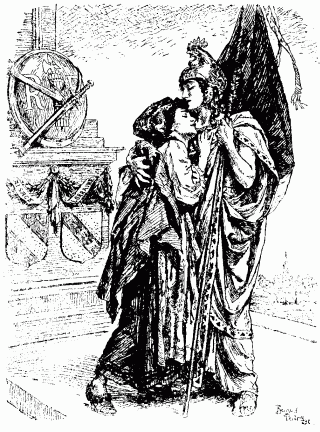
Punch and the Great War
Project Gutenberg has a collection of
Punch cartoons and commentaries from World War One. This one comes from 1918: the reunification of Alsace-Lorraine with France.
Random Notes
With regards to my recent posts on German capital cities,
Bonn has been divested (auf Deutsch) of its status as a center of the federal government. Too bad--the city of Beethoven is much more pleasant than the imperial capital. Hopefully it won't become a suburb of Cologne.
Brandon has (part of) the new
Carnivalesque up. It has some great contributions from talented historians (you know, they do stuff before 1800) like
Sharon and
Claire. BTW, the latter is calling out to early modernists to start up a
group blog (isn't Blogger cool?).
On another note, Natalie at
Philobiblion is developing an indispensable blog on women's history (particularly British women). Check out this post on the
Friendly Female Society.
David at Barista has a post on
alter-egos in blogging.
Some of you may be sensitive about the overlap of politics and religion right now, but I recommend you check out
Nuno's pictures of voting in his Jewish neighborhood in L.A. (I think it is the Fairfax area).
Specter of West Berlin
I happened upon a book that deals with the development of the two Berlins that was written in 1988. TH Elkins'
Berlin: the Spatial Development of a Divided City has been made obsolete by the fall of the Berlin Wall (I sure he kicked himself when it occurred only one year later).
Elkins' prognosis for West Berlin was grim. The city was an island separated from the Federal Republic. It relied on all sorts of financial assistance from the main country, especially for transportation. The federal republic could do little for West Berlin that did not requires diplomacy with the DDR. Politically, West Berlin did not have full rights as a German
Land. It could not vote for the federal chancellor, and it could not select its federal representatives by popular vote. There was a sense that West Berlin was becoming alien to the federal republic: it was developing differently, and there was a sense that this once-great metropolis was becoming provincial. According to Elkins:
West Berlin, it can be argued, so rigorously shut off by an unsympathetic neighbor, is no longer an essential component of German life.
By comparison, East Berlin was the legitimate capital of the DDR and a thriving city. The futures of the two half-cities could not have contrasted more. In the 1980s the ruling SPD considered negotiating a new status for the city--neither east nor west, a bridge between the federal republic and the people's republic.
The Urban Strategy
Forget the South. Forget the Mid-West. For that matter, forget the Pacific Coast, Southwest, Northeast, and New England. Forget them all. Playing the maps of American super-regions and states will make certain that Democrats lose every time.
I have been staring at this
map of voting results by county. On the surface it looks more bleak that the states map: vast spaces of Republican red barely penetrated by blobs of Democrat blue.

I have stared at the counties map a lot, trying to figure it out. It shows where Democrats have their strength: areas along borders, urban networks, maritime ports. Almost all of their victories came from urban counties. The most surprising result for me was all the blue that surrounds the Mississippi River.
The counties map might tell of dwindling influence, but it also shows a clear advantage. Those blue spots produced almost as many votes as all that red. They are cities and their regions. It might be useful for the Democratic Party to concentrate on its urban politics (economic development, safety and policing, anti-terrorism) as a means of attacking many places at once. Furthermore, they should not limit planning to the cities themselves, but to their suburbs as well. Get people to realize that they have a stake in the health of their nearby metropolis.
Alsace Hate Watch
Over the weekend
another Jewish cemetery in Alsace was vandalized. This time it was in Brumath, a town north of Strasbourg. The town council gave
19,000 euros to the restore the damaged headstones.
Come on, guys, get writing!
A reminder:
Carnivalesque is trying to get posts concerning early modern history (1450-1850) from about anywhere in the world. I know some of my Americanist friends (Brdget, Johno?) can whip something up in a jiffy. You can get details
here:
Don't forget: the Early Modernists’ Carnival, Carnivalesque, is coming to Houyhnhnm Land (pronounced “whinnim” or “hwinnimn"), my other weblog. The date will be November 5 (probably late in the evening). If you have written a post in September or October (the first few days of November will be OK, too), or have in surfing the blogosphere come across a post, on the early modern period (broadly conceived - from about 1450 to 1850), send it my way. You can email me through the “Email” link at Houyhnhnm Land, or directly through the following address:
branem2[at]branemrys[dot]org
I will contribute my two posts from this week on Bucer (which will continue into next week--too much fun stuff on him).
Martin Bucer part II: Discipline and the Ecumenical Church
This is part two of what will be a four part series on the Strasbourg reformer Martin Bucer and his motivations in the Abendmahlstreit. You can read part one here.
Bucer’s theology appears to be a bizarre mixture of condemnation and accommodation with Roman Catholicism. One could go down the list of rites and find places where Bucer condemned the spirituality of practices but recommended that they should be preserved. Bucer was not convinced that the break from the Catholic Church would be permanent. Not only did he believe in reconciliation with Rome was possible, he worked toward it. Moreover, Bucer believed that unity was of the Church was essential for the mission of Christianity. He was appalled by the schismatic tendencies within Reformation theology, and he tried to contain entropy. His theology reflects the need to maintain the discipline of the Christian community, especially the urban community.
On the surface Bucer’s criticisms of Catholic ritual are contradictory. Bucer rejected the spiritual importance of most Catholic rites, but he refused to call for their abolition. Confirmation played no role in the spiritual development of the individual, but Bucer suggested that it could be reformed for practical purposes. Instead of a religious rite, confirmation could be transformed into a statement of faith and obedience by adults. It would play the same role as the citizens’ oath that adults would take to the urban polity, but it would unite that polity in spirit as well. Furthermore, he wanted membership in guilds and other associations to be tied to the oath. Similarly, Bucer rejected the clergy as spiritual intermediates, but he assigned them a central role in spiritual life as the main source of religious instruction. Priests should monitor the behavior of their congregations, admonishing those who fell outside of good moral practice. They should compel parishioners to attend adult catechisms to reinforce learning and discipline.
Bucer rejected the notion that priests were conduits for repentance: they need not preside over confessions, but they could help make the confession more meaningful for the repentant. The clergy were, therefore, different types of authorities than under Catholic doctrine. They formed the spiritual community that would nurture individuals. They instructed, examined, policed, and counseled, but the individual was still responsible for his or her spiritual health. In fact, one contemporary critic, Andre Seguenny, claims that Bucer did not address the individual but the social: the individual, acting without guidance, could poison the rest of the community. The body of rituals, practiced in the context of the community, affected the behavior of individuals, and they took that with them into the larger community. (At some point I will comment on the relationship between the spiritual space of the Church and the urban space in Bucer’s teachings).
Could it be claimed that Bucer wanted to change the foundations of Christianity without changing its forms? Catholic ritual was familiar. Rites affirmed the cohesion of church communities. It was the product of traditions that allowed the Church to thrive and spread, and thus was an essential instrument of its mission. Because of their utility, rituals should not be abandoned. Bucer, who believed that the “end times” were near (as did many reformers), was cautious about making too many changes. Radical changes to the outward appearance of the Church would be dangerous. The mission of the Church must proceed, and as many people as possible must be brought into the Church community. Rather than discontinued, many rites should be examined and reformed. It should be made clear that they are not the essence of salvation.
Perhaps Bucer’s theology could be described as symbolic iconoclasm: undermining the spiritual import of ritual, but ascribing social and political purpose. The destruction of religious symbols was not as widespread in Strasbourg as it was in other cities (especially Basel). The city magistrates preserved as much of the religious art as it could. Some pieces were locked away. Others were put on the periphery of ritual spaces so that they could not become objects of devotion. The Reformation in Alsace had a certain conservatism. Religious art was the product of a powerful oligarchy that did not want its authority challenged. Jacob Sturm dragged his sister from the convent and defrocked her, but he would not approve of radical changes in worship or the reconfiguration of ritual space. Bucer proposed reforms that did little to change the appearance of ritual, allowing to coexist with the practices that the Church had already developed. (With regards to iconoclasm, Bucer believed that art was important for instruction, but he felt that the art that was produced in previous centuries was insufficient for that task.)
Bucer’s concern for the “end times” reflected his attitude toward the cohesion of the Church. He was alarmed by the tendency in reform for communities to break off to form their own churches. Schisms had affected the diplomacy of the Germans cities, setting themselves against each other for minor, but firmly held, theological differences. Bucer was one of the few voices that called for unity. He would constrain his own writings so that they did not address problematic issues directly, but talked around them, providing some meaningful ground for compromise. He also tried to bring together the ideas of the clergy who worked around them, refusing to institute his authority over them (despite the fact he guarded that authority). This became characteristic of his ecumenical diplomacy: finding broader meanings that could be affirmed, allowing reformers to work together. However, his voice lost its urgency, and perhaps, some of its appeal.
Part three should appear some time over the weekend, probably Saturday afternoon. I will also write a conclusion about the importance of Bucer for faith in the Rhine region and its effects on spatial practices. BTW, I might sometimes write Buber instead of Bucer. I am conscious that some of the attitudes of Bucer's toward interdenominational and interfaith dialogue resemble those of Jewish theological Martin Buber, but there is no connection between them.